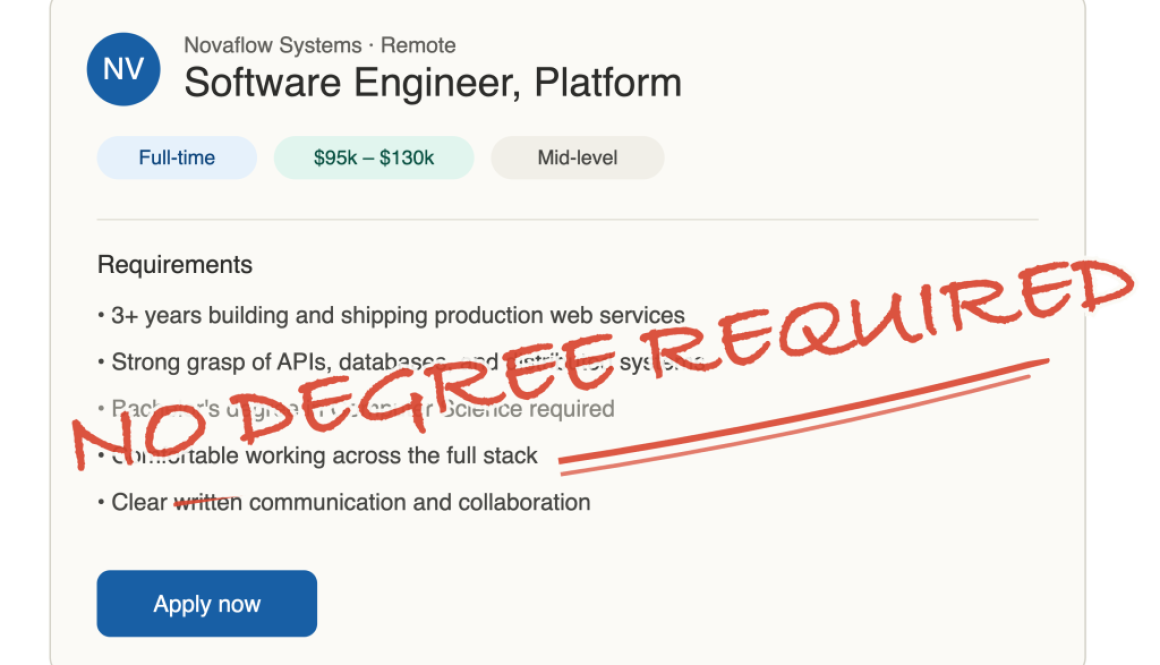
Skills-Based Hiring: Why Some Employers Are Dropping Degree Requirements
Ever stared at a job posting that sounded perfect for you—until you hit that one line? “Bachelor’s degree required.” And just like that, the door felt closed.
That trend is starting to change.
Something big is shifting in how companies hire. More and more employers are letting go of strict degree requirements and asking a different question instead: Can you actually do the job? It’s called skills-based hiring, and it’s changing the rules in a way that could work in your favor. Let me walk you through what’s happening and how you can make the most of it.
What Skills-Based Hiring Actually Means
For decades, a college degree was the gatekeeper. It was the box you had to check before anyone would look twice at your application. The degree became a kind of shorthand—proof, employers assumed, that you could learn, show up, and get things done.
Skills-based hiring flips that logic. Instead of asking where you went to school, employers focus on what you can do. Can you write clean code? Manage a project? Close a sale? Solve the problem in front of you? If the answer is yes, the diploma matters a lot less than it used to. Mind you, it’s not worthless–the degree still can help–it’s just not the final determinant or the barrier to entry.
Think of it like hiring a chef. You wouldn’t turn one away because they learned in a family kitchen instead of culinary school—not if the food is incredible. Companies are starting to apply that same common sense across the board.
Why This Shift Is Happening
So why now? A few forces are pushing this change, and understanding them helps you see where the opportunities are.
- There aren’t enough people to fill the jobs. In many fields, employers simply can’t find enough qualified candidates. When you’re desperate for talent, an arbitrary degree requirement starts to feel like a self-inflicted wound. So companies are widening the net.
- Bootcamps and certifications proved themselves. Coding bootcamps, Google Career Certificates, industry credentials—these fast-track programs turn out capable people in months, not years. Employers have noticed. Many of these grads perform just as well (sometimes better) than traditional degree holders.
- Remote work changed what matters. When your team is spread across time zones, results speak louder than pedigree. Did the work get done well? That’s the question. Where you learned to do it fades into the background.
- College got expensive. Really expensive. As student debt climbed, plenty of talented people chose other paths—and employers realized they’d be missing out on great candidates if they kept demanding a costly credential.
- Tech led the way. Companies like Google, Apple, and IBM publicly dropped degree requirements for many roles. When the biggest names in the room make a move like that, everyone else pays attention.
What This Means for You
This trend creates real opportunities for job seekers—and a few new challenges. Let’s be honest about both.
- The opportunities are exciting. If you’ve built skills through work experience, self-teaching, a bootcamp, or a career pivot, more doors are open to you than ever before. You’re no longer boxed out by a piece of paper you don’t have. Your actual ability becomes your strongest selling point. That’s a genuine shift in your favor.
- But there’s a flip side. When degrees stop being the filter, proof becomes everything. You can’t just claim you have skills—you have to show them. That means the burden is on you to demonstrate what you can do, clearly and convincingly.
The good news in all this is that showing your skills is entirely within your control. A degree takes years and serious money. Building proof of your abilities? You can start on that this week. That’s a good trade.
How to Adapt and Get Hired
So what do you do to adapt to this trend? Here are five practical moves that will help you thrive in a skills-first hiring market.
1. Build a portfolio that shows your work
A portfolio is your evidence. It’s the difference between saying “I’m good at this” and proving it. Designers, writers, developers, marketers—almost every field benefits from a collection of real work samples. No professional experience yet? Create sample projects. Volunteer your skills. Do a mock project for a fictional company. The goal is simple: give employers something to see, not just words to read.
2. Earn certifications that matter in your field
Certifications are a fast, focused way to prove you’ve got specific skills. Google, HubSpot, CompTIA, Coursera, and dozens of others offer respected credentials you can earn in weeks or months. Pick ones that are recognized in your target industry. They signal to employers, “This person invested in the skill you need.”
3. Build your resume around accomplishments, not credentials
Rewrite your resume around what you’ve achieved, not just where you’ve been. Instead of “Responsible for social media,” try “Grew Instagram following by 40% in six months.” Numbers and results grab attention. They tell a story about impact—and impact is exactly what skills-based employers are hunting for.
4. Speak the language of skills
Study the job posting closely. Notice the specific skills it calls for, then mirror that language in your application. If they need “project management” and “data analysis,” make sure those exact skills show up clearly in your resume and cover letter—backed by real examples. This also helps you get past the automated systems that scan applications before a human ever sees them.
5. Keep learning (and make sure to mention it)
Skills-based employers love candidates who grow. Take an online course. Learn a new tool. Then talk about it. Mentioning what you’re currently learning tells employers you’re the kind of person who adapts and improves—someone worth investing in. Eagerness to grow can matter just as much as what you already know.
The job market is finally starting to value what you can do over where you happened to study. That’s a real opening. But let’s don’t pretend it’s automatic. Standing out in a skills-first world still takes a clear strategy, and figuring that out by yourself can feel overwhelming.
If you’re ready to translate your skills into offers—to build a portfolio that turns heads, sharpen your resume, and walk into interviews with confidence—let’s talk. Book your free initial consultation today, and let’s map out a plan built around your strengths.
Your next opportunity may be closer than you think. Let’s go get it.